Tuesday, April 19, 2011

The Blues

Joe "Blue," bringing down the house
When it comes to music, I prefer long ballads and poetry.

But I married a blues musician. Our first years of wedded bliss included dancing every weekend -- with me thinking, "You're not going to repeat that line again, are you?"

The structure of a blues song is so simple it seems cruel. Usually there's nothing more than three stanzas with two repeating lines, followed by a third line -- that replies to the repeating line!

It's enough to drive a novelist straight into the arms of William Faulkner.

But a funny thing happened on the way to growing up: My appreciation for The Blues has deepened every year.

Rock music can obscure any shallow sentiments with decibels and lightning guitar licks. Folk singers can pirouette on brilliant phrasing, even if there's no feeling involved. Grunge grinds down on despair, proving misery loves company. And rap -- well, let's just say rap doesn't belong in this paragraph about music.

Meanwhile, the simplicity of a Blues song works like an auger for truth. The song's meaning doesn't come from its words or fancy chord progressions. Its meaning comes from the heart, and the repeating lines underscore the sentiment -- sorrow, pain, loss, affliction.

A good novelist can't simply type a book. And a true Blues musician can't just sing a song. The common goal is to reach the heart. Which often requires bleeding in public -- on purpose.

Some religious people describe The Blues as "the devil's music." But I think it's closer to the opposite. It's about those sighs "too deep for words."

Recently The Hunk of Italy and I attended the Washington Blues Society's annual awards show. For the second year running, The Hunk was nominated for best blues harp while his band -- Hot Rod's Blues Review -- was nominated for best band. (By the way, double nominations two consecutive years doesn't means poor supply. Just the opposite. Most states are fortunate to have one blues society. Washington has six -- six! -- grooving the Northwest from the Oregon border up to Canada and across the Cascades into Spokane. From April to October, there's a blues event nearly every weekend.) Although The Hunk lost to the gracious and equally talented Jeff Herzog, it was a lovely night at The Triple Door.

And it reminded me once again why The Blues and the people who play it are so special.

Here's the short list:

Age. Other than the beautiful Stacy Jones, who can belt it out like LouAnn Barton, most blues musicians are pushing 40 or 50. A serious percentage are giving 60 new meaning. And since age generally matures the heart, the older the musician, the better his Blues.
      Take that, MTV.

Tone. Not just musically, but conduct. As wild, individualistic, and imaginative as these musicians are, nobody's shouting a blue streak through the microphone or grabbing his crotch or pulling a gun in the parking lot (although those impulses might wind up in a Blues song).

Men in suits. Zoot suits. Double-breasted sharkskin. Suits as green as parrots. Blood-red smoking jackets. Paired with two-tone oxford shoes. And fedoras.
       Man, it's style.

Finally, most importantly, Truth.

These songs of pain and sorrow celebrate life.

Yes, it's a paradox.

Just like another paradox.

A homeless guy was tortured and mutilated and hung on a cross for everybody else's faults -- and we call that day "Good Friday." Scandalous and beautiful, the greatest story ever told reads a lot like a Blues song. A fallen world, the wicked human heart. A fallen world, the wicked human heart. But God came back, He came back.

Now get up and boogie.

Get up and boogie.

Friday, April 15, 2011

Poetry Month

In honor of poetry month -- which, really, deserves to be 12 months long -- I dipped into one of my favorite anthologies.

"Northwest Verse" was published in 1931 by Caxton Press of Caldwell, Idaho.

Most if not all of these early poets from Washington, Oregon, Idaho and Montana have been forgotten. But here is just one of its delicious offerings:


   Notes on a Concert

While scientists debated whether
'Twere wise to publish their decision,
The morning stars sang all together
In gay derision.

They said: "This planet is the greater,
And that the less, of those before us."
The stars lampooned each commentator
In ribald chorus.

Antares, Betelguese and Mira,
The big and little constellations,
Sang "fol-de-rol" and "tira-lira"
With variations.

For stars have little else to do
But chant in praise or sing in revel,
And glorify what things are true,
And shame the devil.

But the astronomers still peer
Through telescopes, and jot down data;
They are too occupied to hear
The great cantata.

And one will wag his beard and say:
"Behold, I've solved a hard enigma;
This star, ten billion miles away,
Shall be called Sigma."

                                              ---Stoddard King

Tuesday, April 5, 2011

Trivia!

Thanks again for making the Raleigh Parteigh on Facebook such a wonderful event!

I can't think of better company than a lively group readers. Thanks for the smart and witty comments, beautiful pictures, and funny answers.

I'm grateful to each of you for coming out to play Tuesday night.

And because some of us require closure (your humble scribe included) the trivia answers are posted below.

See you at the next Raleigh Parteigh!


What did I do for work before I was an author? Newspaper and magazine reporter (also worked as a farm hand and bartender)

How many books are there in the Raleigh Harmon series? Five, counting next year's release, "The Stars Shine Bright."

How many daughters do I have? NONE! I have sons.

Do you think I have a subscription to Scientific American? Nope. And if you read the blog, you'll see why....

Now, for those of you who have read The Mountains Bow Down – here’s a few questions about the book:

Geert Van Broek is head of ship security. What country is he from? Holland. Bonus question: What agency trained him in law enforcement? Royal Marechaussee

How does Special Agent Jack Stephanson get to Alaska? He flies his plane.

What is a phillumenist? Someone who collects matchbooks. Bonus: Why does that word have two Ls? Because one root of the word comes from Greek (phila) and one root comes from Latin (luma).


Where does Raleigh's mom always go to find peace for her troubled mind? Church or chapel -- God's house.

What is the name of Aunt Charlotte's New Age store? Seattle Stones.

DeMott Fielding's family has lived on the same Virginia estate since the early 1700s. What is the name of that property? Weyanoke. BONUS: Can you name two of DeMott's family members? MacKenna and Jillian are his sisters. Harrison is his father. And Peery is his mother.

And the winner is ... Was it YOU?


I'm thrilled to announce that

Cathy Wilcox from Texas

will soon be sailing on the high seas because she has won a $500 Vacations To Go gift certificate to put toward the cruise of her choice! Amy from Litfuse Publicity Group will be in touch for your info Cathy - congrats.

And thank you to everyone who entered and helped Spread the Word about The Mountains Bow Down!

Wednesday, March 30, 2011

On this day, in 1867, the United States paid Russia $7 million for Alaska. Personally, it's my favorite purchase. 

But the anniversary has me thinking about how much the state has changed, particularly in recent years.

My great-grandparents arrived in Juneau in 1885, and my grandmother was born that same year, the youngest of eight children. She was rumored to be the first caucasion baby born in Juneau. At age five, she was kidnapped by Tlingit Indians. Her eldest brother later saved her, toting his best shotgun. 

 My grandmother's story was later dramatized in a play, "Hootchinoo and Hotcakes." The play was primarily staged for tourists who came to town by cruise ship. But sometime during the 1970s, a bunch of folks moved to Juneau from Outside -- the lower 48 states. They didn't like the play. It was "culturally insensitive." "Politically incorrect."

The play was taken off the stage.

Despite historic fact, we weren't supposed to say that during territorial days the Tlingit Indians behaved like ruthless savages. But they did -- and good for them. The Tlingits were the only Alaska Native tribe the Russians couldn't conquer. And that's saying something: The Russians were plenty ruthless too.

Six years ago I went back to Juneau for my parents' memorial services. At the time my youngest son was five. He wore a coonskin cap and carried a toy rifle wherever he went -- even to bed. Having heard the heroic story of his great-grandmother's rescue by shotgun, he wanted to find a toy replica in Juneau.

But the Juneau toy store owner told us she didn't carry guns -- not even cap guns. She couldn't. "I would like to carry guns, but the parents in town would boycott my store. They'd drive me out of business."

Our son was crushed. So we walked down the block to the bakery, hoping a doughnut would lift his spirits. When we walked into the bakery, a bunch of boys immediately gravitated to the kid with the coonskin cap and toy rifle. Happily, our son let them hold the rifle. He let them pet his hat. And his face beamed. But suddenly women began rushing forward, yanking the boys away.

I didn't understand. Until one of the women stomped up to me and declared: "WE don't play with guns!" 

I wanted to shoot her. 

That afternoon, we went back to the house where we were staying. Our host was a dear old family friend who had lived in Juneau for eighty-five years. Born and raised in Alaska, and a die-hard Democrat, he was instrumental in drafting the state Constitution, and later served as a highly respected judge. He was also a WWII veteran, having served with the 10th Mountain Division. When he saw my son's interest in weaponry, he brought out his old Army .45. What a thrill!

But somebody in the room wasn't happy. She was, in fact, head of Alaska's department of fish and game. Though she didn't grow up in Alaska, she was now in charge of telling Alaskans how to manage their living natural resources. And here's what she told us: We were encouraging "violence" by encouraging our son's appreciation of this historic weapon. (Nevermind how she glared at the toy rifle.)

Back when "Hootchinoo and Hotcakes" got banned, the Outsiders came north in droves to work on the oil rigs. But just as many came to Alaska as environmentalists and lawyers and "activists" of various stripes. As a girl growing up, it seemed like an exciting time. The Alaska Pipeline was going to change everything -- there were even rumors we would get TV reception. 

But I can still remember the day in August, 1974, when I begged my dad to buy me a sweatshirt that showed a picture of the Pipeline. My dad refused. He refused to buy anything heralding the Pipeline. And not because of the oil.

A lifelong Alaskan -- District Attorney during Alaska's territorial days and later a justice on the Alaska Supreme Court -- my dad hated what was happening to his state. Not the jobs. Not the revenue. Those were good, he said.

"But the do-gooders," he said. "They're coming. These are the people who know what's good for you -- better than you know yourself. And they always pave the road to Hell. Someday you'll understand."

At the time, I thought he was wrong. I wanted the sweatshirt. And the Outsiders seemed like very nice people. They just wanted to make things better; they just wanted Alaska to be more like the other states. 

What was wrong with that?

There's a significant rite of passage, and it comes when you realize your parents were right. 

The day after these incidents with the toy rifle, I scattered my dad's ashes in Juneau. My gun-toting five-year-old stood by my side.

I told my dad he was right. 

And then I told him good-bye.

Tuesday, March 22, 2011

Raleigh is back...and she brought some fun with her.

Are you ready to party? Ring in Spring with fabulous gifts? Grab a getaway aboard the cruise of your choice? Then join me for a month of Raleigh Harmon fun!

I'm celebrating the release of The Mountains Bow Down with a blog tour, a Cruise prize pack worth over $500 and a Facebook Party!

The blog tour (see what people are saying here) and Cruise giveaway kicked off last week. The Facebook Party is scheduled for April 5th at 5:00 PM PST (6 MST, 7CST & 8 EST) and we’re going to party like it's 1999 (appreciative nod to Prince, or Symbol, or whatever he named himself). Come rock out at the Raleigh Harmon Book Club Party on Facebook, where I’ll be announcing the winner of the cruise (could be you – picture it. Go ahead, feel that ocean breeze?). The "official" details and points of entry are below!

New to the Raleigh Harmon series? Start fresh with the first book, The Stones Cry Out! It's available NOW on Kindle or Nook for ONLY $2.99! 


One Grand Prize winner will receive:
  • A $500 gift certificate toward the cruise of their choice from Vacations To Go.
  • The entire set of the Raleigh Harmon series.
To enter click one of the icons below. Then tell your friends. And enter soon - the giveaway ends on 4/1! The winner will be announced at Sibella’s Raleigh Harmon Book Club Party on FB April 5th, 2011! Don’t miss the fun – prizes, books and gab!

Enter via E-mail Enter via FacebookEnter via Twitter

About the Facebook Party: Join me and fans of the Raleigh Harmon series on April 5th at 5:00 pm PST (6 MST, 7 CST & 8 EST) for a Facebook Book Club Party. I'll be giving away some fun prizes, testing your trivia skills and hosting a book chat about the Raleigh Harmon books. Have questions you'd like to chat about - leave them on the Event page.

Saturday, February 19, 2011

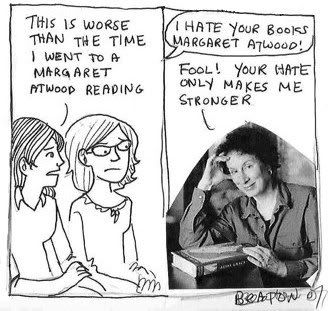
By Kate Beaton
Unless you're running drug rehab centers for Hollywood actors, you've probably had enough leisure time to notice a massive paradigm shift taking place in book publishing.

Brick and mortar stores closing. Borders declaring bankruptcy. Kindles and Nooks and E-Readers. Self-published authors climbing the New York Times Bestseller lists.

Old ideas are passing away.

But nobody knows what will grow from this scorched earth. Current theories range from Amazon ruling the universe -- after fighting Apple for the heavyweight title -- to every writer becoming his own publisher.

When theories cover that much range, the only certainty is uncertainty: Literally, nobody knows.

On that note, a friend passed along this darkly humorous yet telling perspective from author Margaret Atwood. Poet, novelist, literary lioness, Atwood has been writing longer than I've been alive.

Her question was simple: what about the writer?

By modern standards, her presentation isn't short. It's about 30 minutes long -- or 29 minutes forty-five seconds beyond the modern attention span. And the delivery isn't "snappy." But I would encourage writers to watch it for the same reason Atwood's books are worth reading.

I don't always agree with her perspective, but Margaret Atwood comes at things from singular angles. She's one of those writers -- a dying breed -- who will cogitate until some elemental truth appears. Then she applies the rapier word.

When I first stumbled upon her books, I was a teenager who had never heard of her. But she had written a poem that described winter dawn in the far north. The imagery was so clear, so haunting, that to this day I can close my eyes and still see the blushing hues on the frozen tundra. It's as easy as recalling a melody to a favorite song.

Since then I've come to appreciate her as an intellectual who isn't effete. For example, check out the image in her presentation borrowed from the butcher shop.

Morbidly funny, terribly true.

Poetic in its own way.